
Black Walnut Wood: Slabs, Lumber & Custom Furniture from a Texas Sawmill
There is something truly special about working with walnut wood. Whether you are a first-time woodworker or just someone who appreciates beautiful furniture, this rich, dark wood has a way of stopping people in their tracks. And if you have ever walked into a room with a stunning walnut dining table or a live-edge walnut slab countertop, you already know exactly what we mean.
But here is the thing: a lot of beginners feel intimidated sourcing quality walnut wood. Where do you even start? What should you look for? How do you know if you are getting a good deal?
That is where we come in. As a Texas sawmill with years of experience cutting, drying, and crafting black walnut wood, we want to make the whole process feel less overwhelming. In this post, we are breaking down everything you need to know, from understanding different cuts and slabs to exploring custom furniture options. By the end, you will feel confident and excited to start your next walnut wood project.
Why Black Walnut Stands Apart from Every Other Wood
There's a reason black walnut shows up on every serious woodworker's wish list. It's not just one thing. It's the whole package, and each quality stacks on the next in a way that most other domestic hardwoods simply can't match.
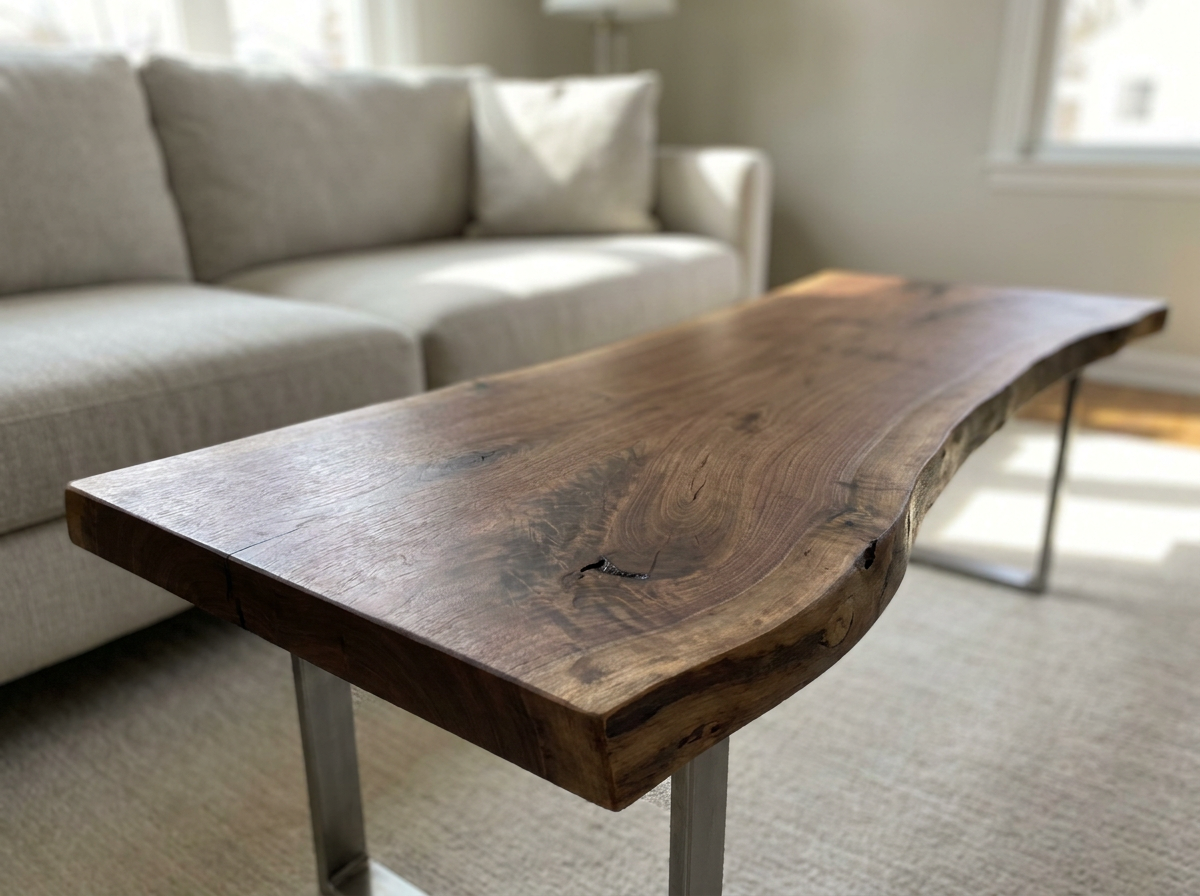
The heartwood-to-sapwood contrast is genuinely stunning. The deep chocolate center of a walnut slab shifts into a pale, almost creamy edge, and that transition isn't something makers try to hide. It's something they design around. Designers and custom furniture buyers actively seek out that contrast, especially in live-edge pieces where the full width of the slab is on display. According to Wood Database's profile on black walnut, the heartwood ranges from pale brown all the way to a rich chocolate with occasional purple and grey undertones, while the sapwood sits at the opposite end, nearly white. That's a built-in design feature you can't replicate with stain.
Walnut also finishes beautifully, and it doesn't need much help. The wood accepts oils, waxes, and topcoats evenly without blotching, which is a problem you'll run into with species like cherry or maple. It's also rated as very durable in terms of decay resistance, meaning surfaces hold up to real-world use. You're not babying a walnut table.
Workability is another quiet strength. With a Janka hardness of 1,010 lbf, walnut is firm enough to resist dents but not so hard that it fights your tools. Hand planes, routers, and table saws all move through it cleanly when the grain runs straight. The Fargo Woodworks comparison between walnut and other species notes this balance as one of the primary reasons it remains a go-to for both professional shops and confident DIY builders.
Then there's how it ages. Walnut doesn't fade or gray out over the years. The heartwood deepens and develops a warm, layered patina through natural oxidation. A walnut dining table genuinely looks better with a decade of light exposure on it than it did fresh out of the shop.
All of this adds up to real market demand. Black walnut is currently one of the most searched domestic hardwood species among buyers, and that interest spans homeowners, woodworkers, builders, and commercial buyers alike.
Texas-Grown Black Walnut and Why It Matters Where the Tree Came From
Black walnut isn't just native to Texas. It belongs here. The species grows naturally across Central and North Texas, part of its original range that sweeps down from the Midwest through the Hill Country and into the western stretches of the state. That matters more than you might think. Trees sourced locally never need to travel hundreds of miles before they even reach a sawmill, which shortens the supply chain and quietly shrinks the environmental footprint attached to every board or slab that comes out of the process.
Here's where it gets interesting. Texas isn't exactly prime walnut country by traditional standards, and that's actually a good thing. The clay-heavy soils, unpredictable rainfall, and long, punishing growing seasons push these trees harder than their Midwestern or Appalachian cousins ever experience. Stress shapes wood. Trees that fight for resources tend to develop tighter, denser grain with more character baked in. According to USDA Forest Service data, black walnut's growth is highly site-dependent, meaning the exact conditions where a tree grows directly influence the timber it eventually becomes. A Texas walnut slab carries a regional identity you simply cannot replicate by importing wood from somewhere else.
The broader lumber market is pushing people toward domestic sources right now too. New US tariffs have driven total duties on Canadian softwood above 40%, and Canadian lumber once accounted for roughly 25 to 30 percent of what the US consumed. That gap has to be filled somewhere. Domestic mills with quality inventory, like Stedman's, are fielding serious buyer interest as a result. Current 2026 pricing for black walnut logs confirms the species is commanding premium rates across every grade, veneer through standard sawlog.
Buying Texas-grown walnut from a Texas sawmill also means the wood moves in a straight line from tree to you. No middlemen stacking margin onto margin. No mystery about where the material actually originated. The story stays clean and traceable, and that traceability is increasingly something designers, builders, and homeowners are asking for by name. Regionally sourced, locally milled, and honestly priced is no longer just a preference. For a lot of buyers in 2026, it has quietly become the standard.
Black Walnut Slabs — What You're Actually Looking At
When a log gets milled into a live-edge slab, the saw cuts straight through the trunk but leaves the natural outer edge completely alone. That wavy, organic curve you see on the side of a walnut table? That's the actual profile of the tree. No trimming, no straightening. The shape that grew over decades stays exactly as it was, which is why two slabs are never the same, even when they come from the same log.
How Slabs Are Measured
Sizing is straightforward once you know the three numbers. Thickness comes first, then width, then length. A slab described as 2.5 inches thick and 10 feet long is a serious piece of material, and it's priced accordingly. At national live-edge retailers, comparable black walnut slabs in that range sell for $800 to $825 or more per slab. Thicker material costs more because more of the tree went into producing it, and the structural options for the finished piece expand significantly.
What Actually Moves the Price
Several things push a slab's price up or down, and they're worth knowing before you start shopping. Grain figure is the biggest one. Walnut that shows curl, crotch figure, or swirling dramatic movement in the grain is genuinely rare, and the community consensus among woodworkers is that pricing has to reflect the gas, labor, drying time, and finishing involved, not just the raw wood. Figured walnut sits at the top of the price range because what you see in a finished dining table or countertop is simply impossible to get from any other material.
Sapwood is another variable. The pale, creamy band that runs along the outside of a walnut slab comes from the younger wood just under the bark. Some buyers love the contrast it creates against the dark chocolate heartwood. Others want it removed entirely. Neither answer is wrong, but how much sapwood is present and what you plan to do with it affects both the price and the processing.
Kiln drying and surfacing add real value. A slab that has been properly dried and flattened is ready to work with. Air drying alone takes roughly one year per inch of thickness, so kiln drying accelerates that significantly and costs extra for good reason.
Why the Sawmill Experience Is Different
Buying direct from a sawmill changes the whole dynamic. You can actually see the slab before any processing happens. You can talk through how you want it cut, how thick to leave it, and whether you want the sapwood kept or minimized. If matched sets matter to you, slabs cut sequentially from the same log can be reserved together, which no online retailer can offer. That kind of conversation just doesn't happen when you're clicking through a product page.
From Log to Finished Piece — How the Process Actually Works
Every log that shows up at Stedman's gets looked at before anything else happens. Diameter, straightness, visible defects — those things tell the sawyer what the log can actually become. Stedman's equipment handles logs up to 36 inches in diameter, so even a wide, old-growth Texas walnut that other mills would turn away gets a real shot at becoming something useful. That capacity matters more than people realize. A lot of portable mills tap out well before that size, which means big trees often end up as firewood when they didn't have to.
Once the evaluation is done, the cutting decisions begin. And this is where things get interesting. The sawyer isn't just running the log through and hoping for the best. Every opening cut is a choice — flat-sawn for dimensional lumber, book-matched slabs for a live-edge table, heavy beams for structural work. The goal is always to find the most visually striking sections of the tree and cut toward them. Walnut's deep chocolate heartwood doesn't run evenly through every log, and a skilled sawyer knows how to chase that figure rather than waste it.
Why Kiln Drying Changes Everything
Here's something a lot of first-time buyers don't expect: freshly milled walnut is full of water. Not a little damp — we're talking moisture content between 60 and 100 percent right off the saw. At those levels, the wood is actively moving, and if it dries without control, it warps, checks, and cracks in ways that ruin a board entirely. That's not a maybe. It's what green wood does.
Kiln drying pulls that moisture content down to somewhere between 6 and 8 percent, which is where walnut reaches stability for indoor use. Properly kiln-dried live-edge slabs should sit between 8 and 12 percent moisture content — anything above 15 percent is still considered green and will keep moving after a piece is built. For furniture that's going inside a home, stability isn't a preference; it's the whole foundation.
Air Dried vs. Kiln Dried — The Real Difference
Air drying does reduce moisture, just very slowly and never quite far enough. A slab sitting in a barn for a year might drop to 12 or 14 percent moisture content, which sounds reasonable until that piece gets installed in a climate-controlled room. Then the wood keeps drying toward the interior's equilibrium and the joints start to open, tops begin to cup, and finish adhesion can fail. Kiln-dried walnut machines cleaner, glues more reliably, and simply behaves better once it's inside a finished piece.
Bringing Your Own Log
One of the more meaningful things Stedman's offers is the ability to bring in your own log. Storm took down a big walnut on your property? Clearing land and don't want to watch a beautiful tree get chipped? Bring it in. The log gets evaluated, milled to your specs, kiln dried, and can even be turned into a finished table or mantel. What was growing in your backyard becomes something that sits in your home for decades. That's a very different outcome than letting it rot in a brush pile, and for a lot of people, it's a genuinely personal one.
What People Actually Build with Black Walnut
Black walnut isn't a one-trick wood. People build everything from massive restaurant bars to quiet home office desks out of it, and the reason keeps coming back to the same thing: the wood looks intentional at every scale.
Dining Tables
Dining tables hold the largest share of the North American wooden furniture market, at 28.3 percent in 2024. That's not a coincidence. A dining table is the one piece of furniture that gets seen, touched, and gathered around every single day. Walnut earns that spotlight. The deep chocolate heartwood reads rich and warm under overhead lighting, and the grain stays interesting no matter how big the slab gets. A six-foot walnut dining table doesn't look busy or overwhelming. It just looks right.
Kitchen Countertops and Islands
A lot of people assume walnut is too precious for kitchen use. It isn't. When the wood is properly kiln-dried and sealed, a walnut countertop handles daily use better than most homeowners expect. What stone and laminate can't do is bring actual warmth into a kitchen. Walnut does. A live-edge walnut island sitting next to white cabinetry creates contrast that no quartz slab can touch.
Bar Tops
Wide walnut slabs are a go-to choice for restaurant bars, home wet bars, and hospitality builds. The species is hard enough to hold up under real use, and it actually gets better-looking over time as the surface develops a worn-in character. There's a reason so many bar owners come back for walnut specifically.
Epoxy and River Tables
This is where walnut really separates from lighter species. The natural contrast between dark heartwood and pale sapwood creates visual tension right across the pour line. Resin colors pop against that deep background in ways that maple or ash simply can't match. Makers and commercial vendors have both taken notice, with dedicated black walnut epoxy table categories becoming standard offerings. You can browse stunning examples of 2025 epoxy table designs to get a feel for just how dramatic the results can be.
Mantels, Shelves, and Desks
A walnut fireplace mantel is one of those single changes that makes a living room feel completely different. It anchors the wall. Floating walnut shelves carry that same weight without the bulk. And with more people working from home than ever before, demand for solid walnut desks has stayed strong. A good desk made from walnut feels like an investment in the space itself.
You Have a Walnut Tree on Your Property — Here's What To Do with It
That walnut tree lying in your backyard right now? It is not firewood. It is not a chipping job. It is timber, and it has real, recoverable value sitting there waiting on you to act.
The catch is that window does not stay open forever. Once a log hits the ground, moisture starts moving in, fungi get to work, and the end grain begins checking and cracking. A tree that came down last month is still very much worth a conversation. One that has been on the ground for a couple of years is a different story. The sooner you move on it, the more you get out of it.
Stedman's works directly with Texas landowners to mill their own logs into whatever the material supports. That could be a live-edge dining table slab, a set of floating shelves, a beam for a mantel, or straightforward dimensional lumber you hold onto for a future project. The walnut that came down in last season's ice storm does not have to become mulch. It can become something you actually keep.
Not every log is going to produce a showpiece slab, and being upfront about that matters. Diameter, straightness, and internal condition all affect what a log can yield. But most structurally sound walnut logs of reasonable size yield something useful, even if it is not live-edge material. A quick call with the mill team is all it takes to find out what yours can become, before any commitment is made.
There is also something that numbers cannot fully capture. A piece of furniture milled from a tree that grew on your land carries a story no retailer can reproduce. The growth rings hold the memory of drought years and wet seasons, of your specific piece of Texas soil.
That kind of provenance is increasingly valued. The reclaimed lumber market was valued at roughly $69.9 billion in 2026 and is projected to reach over $101 billion by 2034, with sustainability and handcrafted character leading consumer preference. Your tree fits directly into that.
Ready to See What Texas Black Walnut Can Do?
Stedman's is not a website with a shopping cart. It's a family-run Texas sawmill where real people answer the phone, walk the lumber yard, and know exactly which slabs came off which logs. That kind of access matters. You get direct pricing, honest answers, and actual context behind every board.
Right now, inventory includes live-edge walnut slabs, kiln-dried lumber ready to work with, and full custom milling for anyone bringing in their own logs. Whether you're sourcing material for a dining table or converting a tree from your own land, the whole process lives under one roof.
The first step is just a conversation. Tell them what you're building, what you've got, or what you're trying to figure out. From there, everything gets easier. Reach out to Stedman's and see what's currently in the yard.
Conclusion
Black walnut wood is one of the most rewarding materials you can work with, and getting started does not have to feel complicated. Here are the key things to remember: always source your lumber from a reputable sawmill that prioritizes proper drying and cutting, take time to understand the difference between slabs, live-edge pieces, and dimensional lumber, and never underestimate the value of working with someone who can guide your project from raw wood to finished piece.
At our Texas sawmill, we are passionate about connecting people with quality black walnut that will last generations. Whether you are building your first project or commissioning a custom furniture piece, we are here to help every step of the way.
Browse our current slab inventory, reach out with your project ideas, and let us help you create something truly unforgettable. Your next favorite piece of furniture is waiting.