
How Is Live Edge Furniture Made?
There is something different about sitting at a table that still looks like it remembers being a tree.
You can see where the trunk widened. Maybe there is a knot near one corner, a natural split running through the grain, or an edge that curves instead of following the ruler-straight lines found on conventional lumber. Those details are exactly what make live edge furniture so appealing.
But how does a rough log become a finished piece of furniture?
The answer involves considerably more than attaching legs to a slab.
Creating quality live edge furniture is a slow, deliberate process involving milling, drying, design, woodworking, sanding, finishing, and plenty of judgment along the way. The goal isn't to erase the character of the wood. It's to bring that character forward while turning it into something practical enough to use every day.
Here's how the process works.
Where Does the Wood for Live Edge Furniture Come From?
The story usually begins with a log.
That log might come from a tree that had to be removed because of disease, construction, storms, age, or other circumstances. Instead of becoming firewood or disappearing into a landfill, the trunk can be milled into valuable slabs.
This is where professional sawmill services become important.
A sawyer evaluates the log before cutting it, looking at its species, diameter, length, defects, grain direction, and overall condition. One log may be better suited for thick dining table slabs. Another might contain unusual grain that makes it ideal for a smaller coffee table or statement piece.
For people sourcing their own wood, searching for a sawmill near me can be a good starting point. Local mills may offer everything from basic log milling to more specialized custom sawmill services, allowing the cut to be tailored to the intended project.
That customization matters.
The way a log is cut determines what the grain will eventually look like. A few inches of additional thickness can also make a significant difference when a slab is later flattened, sanded, and finished.
How Are Logs Cut Into Live Edge Slabs?
Once a suitable log reaches the mill, it is positioned for cutting.
Instead of turning the entire log into standardized boards, the sawyer can cut it into thick slabs. The outside contour of the tree remains visible along one or both edges.
That's the “live edge.”
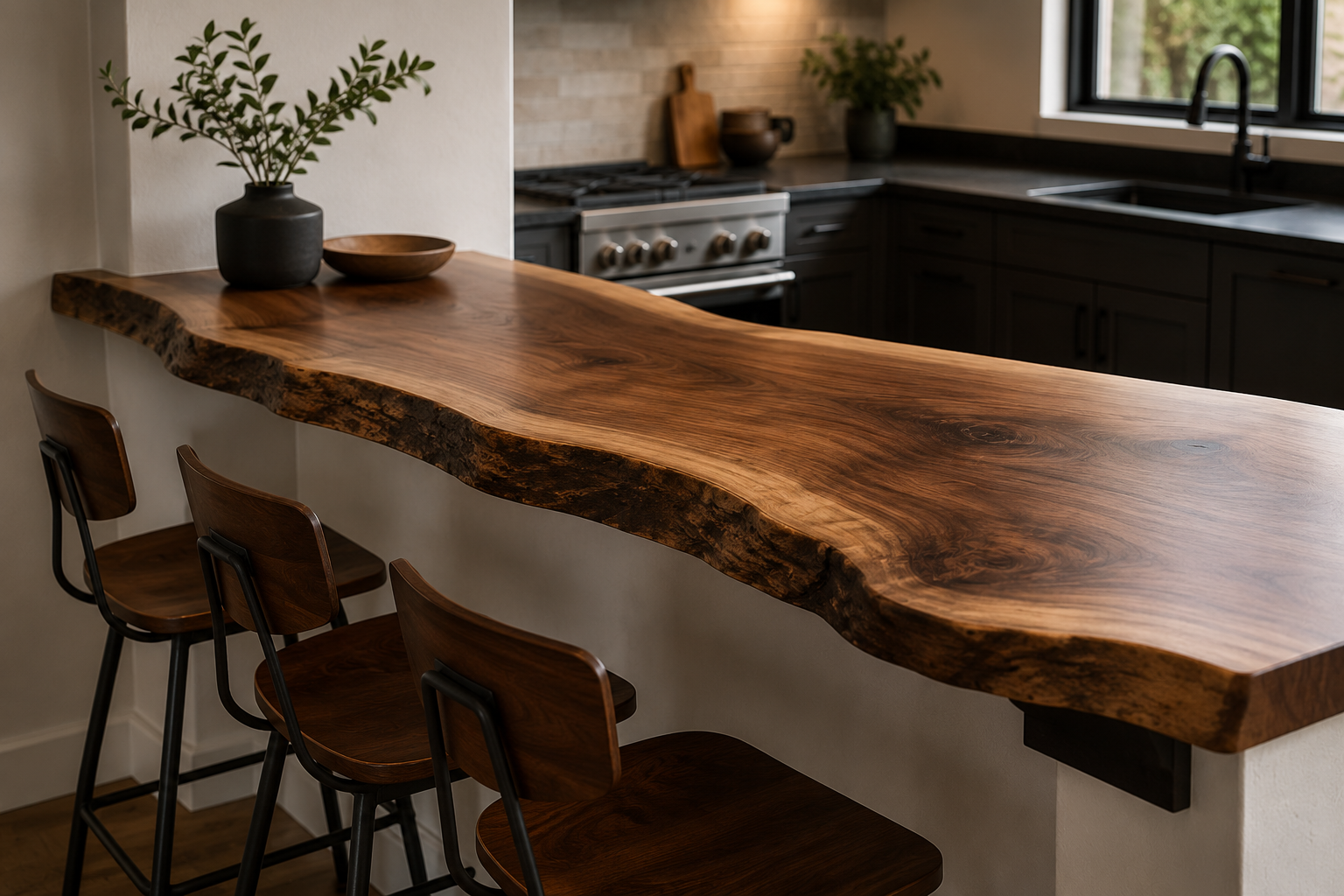
This process reveals what was hidden inside the trunk: flowing grain, color variation, knots, mineral streaks, spalting, burl formations, and sometimes dramatic cracks or voids.
No two logs behave exactly the same way.
Even two slabs cut from the same tree can have noticeably different personalities. One may have a relatively calm grain pattern, while another contains sweeping lines that almost look painted.
That's part of the appeal when shopping for live edge slabs near me. You're not simply selecting a piece of lumber. You're choosing a particular section of a tree.
Why Does Live Edge Wood Need to Dry?
Freshly milled wood contains a surprising amount of moisture.
It can't simply be taken from the sawmill, turned into a tabletop, and expected to remain perfectly flat. As wood loses moisture, it naturally shrinks and moves. If that movement isn't properly managed, a finished table can develop cracks, warp, cup, or twist.
Drying is therefore one of the most important stages of the entire process.
Slabs may be air-dried, kiln-dried, or handled through a combination of methods depending on the species, thickness, and desired moisture content.
Air drying is slower. Sometimes much slower.
Kiln drying can accelerate the process under controlled conditions, but it still requires careful management. Drying a thick slab too aggressively can create problems of its own.
A skilled furniture maker understands that wood is still a living, moving material in a practical sense. Even after the tree has been harvested, the material continues responding to its environment.
Temperature changes. Humidity changes. Seasons change.
The furniture has to be built with that reality in mind.
How Is a Live Edge Slab Prepared for Furniture?
Once the wood has reached an appropriate moisture level, the real transformation begins.
The slab is inspected carefully. The maker looks for movement, cracks, loose bark, weak areas, insect damage, and other features that could affect the final piece.
Then comes flattening.
Because slabs rarely emerge from the sawmill perfectly flat, a large flattening machine, router sled, or similar equipment may be used to create a stable surface. The goal is not necessarily to make the wood look manufactured. It's to give the slab enough consistency to function as furniture.
The natural edge remains.
Cracks and voids may be stabilized or filled. Some makers use contrasting materials to emphasize those openings, while others prefer a subtle repair that keeps attention on the wood itself.
Then the sanding begins.
And continues.
And continues some more.
The surface gradually moves from rough and freshly milled to smooth enough for bare hands, meals, books, laptops, coffee cups, and everything else a table encounters.
How Are Live Edge Tables Designed and Built?
This is where craftsmanship and creativity start to collide.
The slab itself often determines the direction of the design.
A particularly wide slab might become a dramatic dining table. A narrower piece could work beautifully as a console, desk, bench, or coffee table. If two slabs have complementary grain patterns, they can sometimes be joined to create a larger surface.
The base matters, too.
Metal legs can give a slab a clean, contemporary appearance. A substantial hardwood base creates a warmer, more traditional feel. Pedestal designs can make a large tabletop feel visually lighter.
There isn't one correct formula.
That's why custom live edge tables are so popular. The customer can select the dimensions, wood species, edge profile, base style, finish, and overall aesthetic instead of trying to squeeze a particular slab into a predetermined design.
The same principle applies to custom wood tables more broadly. Good custom furniture begins with the space and the way the piece will actually be used.
A dining table for six people has different requirements from a conference table, home office desk, or occasional table.
How Are Epoxy River Tables Made?
Then there are epoxy river tables, which take the natural character of live edge slabs in a completely different direction.
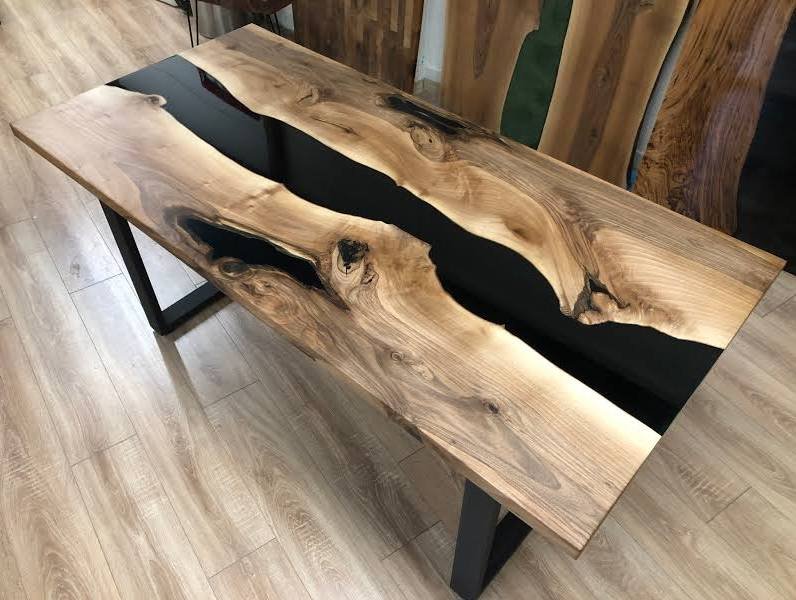
A typical river table uses two pieces of live edge wood positioned opposite one another. The irregular edges face inward, leaving a channel between them.
That channel becomes the “river.”
The slabs are secured inside a mold, and carefully prepared epoxy resin is poured into the opening. Depending on the design, the epoxy may be clear, tinted, translucent, or heavily pigmented.
After the resin cures, the entire surface is flattened and sanded.
The result can be striking.
A natural crack becomes a design element. An irregular void becomes the center of attention. Grain seems to flow into the colored resin, creating a visual contrast between organic wood and a perfectly smooth surface.
Epoxy river tables aren't necessarily better than traditional live edge tables. They're simply different.
For customers looking for something highly personalized, custom epoxy river tables can incorporate specific colors, wood species, dimensions, edge profiles, and base designs.
How Is a Live Edge Dining Table Finished?
Finishing is the stage where the wood's appearance really comes alive.
After the slab has been sanded to the appropriate level of smoothness, the maker applies a protective finish.
Different finishes create different results. Some leave the wood looking natural and understated. Others deepen the color and bring out the contrast in the grain.
The right choice depends on the intended use.
A live edge dining table, for example, needs to withstand spilled drinks, food, fingerprints, regular cleaning, and years of daily activity. A decorative console table may have very different requirements.
The finish also influences how the wood feels.
That tactile quality is easy to overlook until you run your hand across a properly finished slab. The surface should feel smooth without losing the visual texture and personality that made the wood interesting in the first place.
What Makes Custom Live Edge Furniture Different?
Mass-produced furniture is designed around repeatability.
Live edge furniture is almost the opposite.
The wood itself introduces variables at every stage. The dimensions aren't perfectly standardized. The grain changes. The edge wanders. A knot might sit exactly where a manufacturer would normally want a clean, uninterrupted surface.
Instead of fighting those characteristics, a skilled woodworker incorporates them into the design.
That's what makes custom furniture special.
You can specify a particular length because the table needs to fit between two walls. You can choose a slab wide enough to comfortably seat eight people. You can select a particular wood species because you like its color or grain.
You can also build around the room rather than forcing the room around the furniture.
For someone searching for custom woodworking near me, the most valuable part of the process may be that conversation with the maker: What do you want the piece to feel like? How will you use it? What features of the wood catch your eye?
Those questions can lead to a much better result than simply choosing a size from a catalog.
How Much Does the Process Depend on the Woodworker?
A lot.
Live edge furniture can look deceptively simple. A photograph might show a beautiful slab, four legs, and a glossy finish.
Behind that photograph, however, there may be weeks or months of drying, careful slab selection, flattening, stabilizing, sanding, fabrication, finishing, and inspection.
The woodworker has to understand both the material and the finished product.
Too much flattening can remove character. Too little can leave an unstable surface.
Too much sanding can soften details that make the slab interesting. Too little can leave an unpleasant texture.
An overly thick finish can make natural wood look artificial. An insufficiently durable finish may not survive everyday use.
The best work finds the middle ground.
The furniture should look intentional without looking overly manufactured.
How to Find Quality Live Edge Furniture and Woodworking Services
If you're shopping for live edge furniture, don't judge a maker's work solely by the final photographs.
Ask questions.
Where did the wood come from? How was it dried? What moisture content did the slab reach before construction? How was the tabletop flattened? What finish was used? How are cracks and voids stabilized?
If you're searching for live edge tables near me, visit a showroom or workshop when possible. Seeing a finished table in person can reveal details that photographs don't capture.
The same applies when looking for live edge slabs near me.
Look at the edges. Check the surface. Study the grain. Ask how long the slab has been drying and whether it has been properly stored.
And if you're commissioning a piece, look through the maker's previous projects.
A good portfolio should show variety while still demonstrating consistency in craftsmanship.
From Log to Heirloom
So, how is live edge furniture made?
It starts with a log, but the finished product is the result of dozens of decisions.
The log is selected. It is milled into slabs. Those slabs are dried, inspected, flattened, repaired, sanded, designed, assembled, and finished. Along the way, the woodworker has to respect the material's natural movement while shaping it into something stable and useful.
That is why a live edge table can feel so different from ordinary furniture.
You can see where it came from.
Every curve, knot, color variation, and grain line tells part of the story. The craftsmanship doesn't hide those details. It gives them a place to stand out.
Whether you're looking for a simple natural-edge tabletop, a statement live edge dining table, or an elaborate custom epoxy river table, the same principle applies: the best pieces don't try to make natural wood behave like something it isn't.
They work with it.
And when that balance is done well, the result isn't just a table.
It's a piece of the tree, transformed into something that can remain part of a home for decades.